Scar House
All Creatures Great and SmallScar House is the remote hill farm where the Bramley family’s self-contained life comes into view: a place with no road, reached by rough tracks, where long evenings could pass in stillness and cats were cherished members of the household. Its isolation is practical as well as atmospheric, shaping James Herriot’s journeys there and making the farm the center of a later veterinary effort to protect the Bramleys’ kittens.
Setting and Household
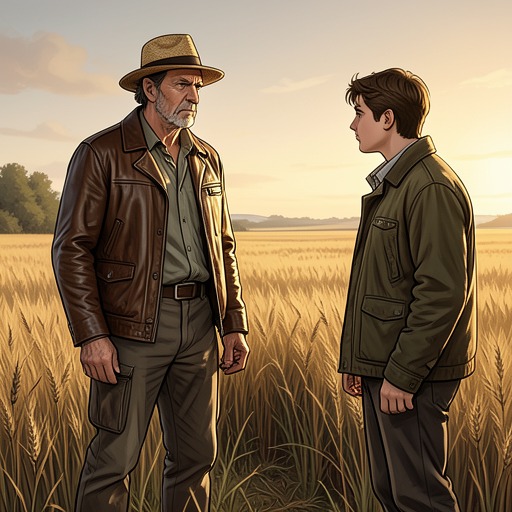
Scar House lay in a wide, shallow depression in the hills. From outside the pub in Drewburn village, its ancient roof tiles could just be glimpsed through the upper branches of the trees that sheltered it. In summer, a car could sometimes be driven across the fields to the farm, but this was only one of two awkward approaches: the other ran through Mr. Broom’s stackyard and along a deeply rutted track passable only by tractor. There was no road to the house.
The farm was home to four siblings: three middle-aged bachelor brothers and their older, unmarried sister, Miss Bramley. Their remoteness was not simply an inconvenience imposed on them. The outside world held little attraction for the family, and they were content to remain at home. Miss Bramley made occasional market-day trips to Darrowby for provisions; Herbert, the middle brother, had gone into town in the spring of 1929 to have a tooth removed. Apart from such visits, the siblings stayed on the farm.
The place also had a busy animal life. The Bramleys kept numerous cats of different kinds, which gathered around Herriot’s car bonnet on cold days, apparently drawn to its warmth. The cats were more than incidental farm animals to the household: when illness began to take them, the family’s distress showed how much affection they had invested in them.
Access and Distance
A call to Scar House took a substantial portion of the working day. In anything but the driest weather, it was safer to leave the car at Mr. Broom’s and continue on foot. The route made the farm’s isolation tangible: travel could mean crossing fields or negotiating deep ruts, rather than following a dependable road directly to the door.
One February night at about eight, Herriot set out to treat a horse with colic. His pockets held possible remedies, including arecoline, phials of morphia, and a bottle of Paraphyroxia. In steady drizzle, he walked along the muddy track, his Wellington boots sinking into the ground. The house lights appeared about half a mile ahead, but reaching them still required twenty minutes of slipping among unseen puddles and opening a succession of broken gates tied with string. The journey was part of the call itself: before treatment could begin, the veterinarian had to cross the difficult ground separating Scar House from the ordinary routes of practice.
The Evening Inside
At the farmyard, Herriot crossed to the back door and paused before knocking. Through the kitchen window, he saw the four Bramleys together in the dim light of an oil lamp. They were packed closely onto a long, high-backed wooden settle against the far wall. Their postures almost matched: arms folded, chins lowered to their chests, and feet stretched out in front. The men had taken off their heavy boots; Miss Bramley wore old carpet slippers.
The family were not asleep, talking, reading, or listening to a radio. They had no radio; they were simply sitting. Herriot watched for several minutes, expecting some movement, but none came. He inferred that this was a typical evening after a day’s work and a meal: the siblings sat together until bedtime. The tableau gives the farm’s remoteness a domestic form. Scar House is not presented only as a difficult place to reach; it is also a household with its own quiet rhythm, largely untouched by the entertainments and habits spreading beyond it.
Herriot later set that way of life against the advance of radio, television, and the motorcar, which had carried the outside world into even isolated places. In his account, the Bramleys remained unusual even in the 1930s, when many farms had not yet been reached by that wider change. Scar House thus marks both a specific, secluded home and a vanishing kind of rural life.
Cats, Illness, and Veterinary Care
A month or two after the night call, cats brought Herriot repeatedly into contact with the Bramleys’ household. As feline panleukopenia (feline infectious enteritis) spread among the animals, Miss Bramley came to Skeldale House nearly every day with an egg basket containing a sick cat or several tiny kittens. Herriot tried salicylates and non-specific injections, sometimes keeping cats at the surgery so he could attend them several times a day, but many died. At Scar House, the losses were visible in the dwindling number of cats and in the family’s grief.
The outbreak made the importance of one particular litter clear. Miss Bramley was especially worried about the five kittens belonging to Topsy, a notably successful line of ratters and mousers. The kittens were about ten weeks old, and their loss would have been a severe blow to the family. With no protective vaccine available to him, Herriot recalled a rumor that Burroughs Wellcome was developing one. The laboratory agreed to supply five doses, reporting encouraging results and asking to hear what happened.
The vaccine was sent to Skeldale House, where Herriot injected the kittens; Miss Bramley pointed out their unusually large ears as she watched. He repeated the injection a week later, when the kittens still looked well, and asked her to report the outcome. Months passed before a grubby envelope, apparently pushed under the surgery door, delivered the Bramleys’ concise reply: the kittens had grown into big cats. The report links Scar House’s isolated household to the wider veterinary world through a small exchange of care, experiment, and news. After the deaths that had marked the outbreak, the surviving kittens offered a rare good outcome—and a measure of hope for the cats still at the farm.